 |

 |
| Who Let the Rattlesnakes Out? |
|
If you are reading this on your cell phone you can probably
double tap this box and it will fill your screen from side to
side, which will make it easier to read. You can double tap
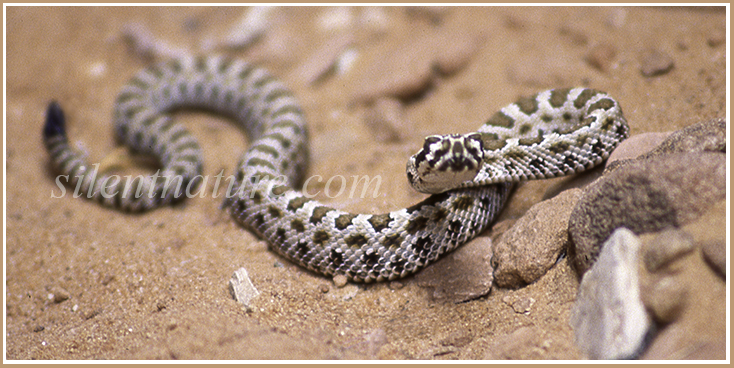
again to zoom back out. The same is true of any of my photos. Fifty years ago my brother was hiking with his friend who stepped in front of a rock and a rattlesnake struck out, just barely catching him by the pant leg but missing the skin. On one occasion my dog, Tecumseh, was running about 30 feet in front of me. I nearly stepped on a snake that was on the same trail he had just sprinted over. Fortunately he had been quick enough that the rattlesnake wasn't prepared for the surprise. On another occasion my friend and I saw a rattlesnake in the middle of the trail directly ahead of us. It stood up with it's head high in the air and challenged us with a loud rattling of its tail. My friend panicked and refused to continue our hike. It wasn't hard for him to persuade me to turn back, an emotional response without any real rational. I think we were both afraid that when we came back down from the mountain he might still be there lurking somewhere along the side of that trail, which is understandable, but in truth there are snakes everywhere everyday, the trail all the way to the top of the mountain was just as dangerous as that stretch in front of us. It's still early in the summer, and over the last few weeks I have received several cautions given by other hikers that have seen rattlesnakes. Having lived in the Salt Lake City area for 27 years, I have seen many rattlesnakes in the foothills there. Strangely enough, for two years now I have hiked every day in the region surrounding Pleasant View, which has the same vegetation, elevation, and climate as Salt Lake, and yet I have not seen a single rattler... but I do know they are there. Rattlesnakes are just afraid of us as we are of them, and the fact that I haven't seen one for two years means they have done a pretty good job of clearing out before I got there. For any of you who can't shake your fear of snakes, take comfort, I started running around in the woods below our house before I was four years old, which was over six decades ago, and for all my hiking I have never been bitten by a rattlesnake. So everyday I take confidence that it is very unlikely I will be bitten today. On the other hand, I have never been struck by lightning, broken an ankle, or had a tree fall on me either, but if I am not cautious any of these things could still happen. It seems to me that all those people who warned me of rattlesnakes wanted to caution me that winter was over now and that the snakes were out and about. But rattlesnakes do not hibernate, they go into a winter sleep, which means that they can still come out of their dens on a warm winter's day. One night as Tecumseh and I slept near Escalante in the back of my pick-up, the overnight temperature dropped to 16 F. In Spooky Gulch that next day I ran into a rattlesnake, even though the day time high never got above 40 F. I save that memory as a warning that even in the winter time I should keep my eyes on the trail, not only checking the surface of the trail, but watching the grass and rocks along the side as much as visibility allows. I always think twice about stepping in front of a rock if I can't see what's under it, and if possible, I would rather avoid that blind spot altogether. I would love to see some rattlesnakes and get some great photos... my only prayer is that I become aware of them far enough in advance to avoid a bite. My brother, Paul, who lives in Pennsylvania sends me photos all the time of the rattlesnakes that he sees. As a word of caution, do not try to take a photo of a rattlesnake unless you have a good telephoto lens and can keep a safe distance. As my current roomate discovered many years ago, if you get too close to a rattlesnake and aggravate it, to defend itself, it can go on the attack and move pretty fast in your direction. Rattlesnakes are an important part of the ecosystem, helping to keep the rodent population in check. In Utah it is against the law to kill, harm, or harass a rattlesnake unless your life is in immediate danger. Fines can run as high as $2500. Never pick up a dead rattlesnake, even after death their reflexes remain active for hours. (Above Photo: The juvenile Great Basin Rattlesnake that I saw in Spooky Gulch, where it was cold enough that his movements seemed sluggish and slow Photo and Story Below: The update just five days after I wrote this story.) |
 |
|
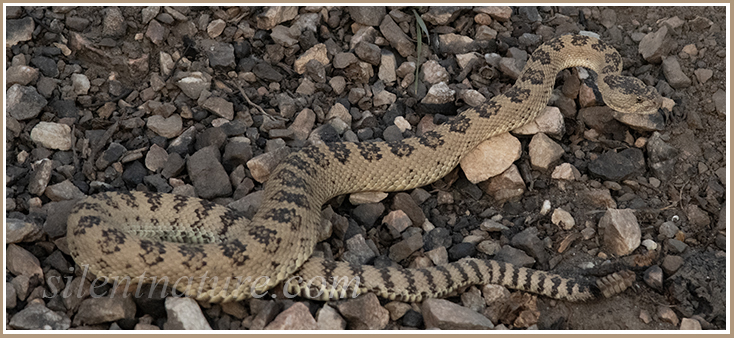
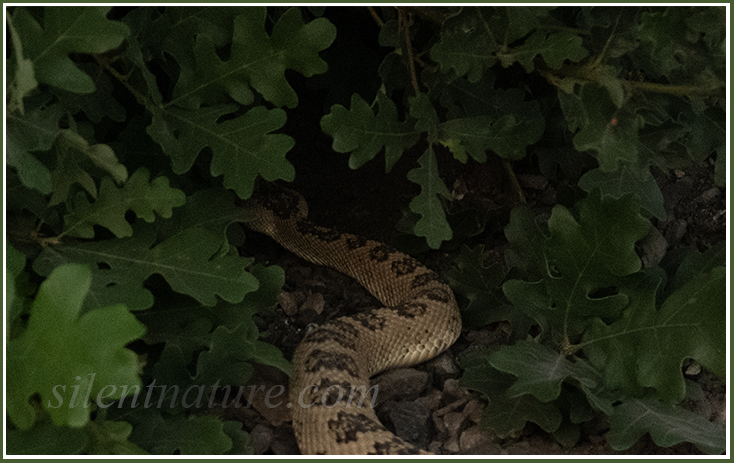
In both psycho-cybernetics and in the metaphysical world they say that what you vividly imagine will become your reality. In the story I wrote above, I revealed that I hadn''t seen a rattlesnake in two years. Perhaps I should have knocked on wood. In just the next five days, as I thought about and discussed with people what I wrote, I ran into two rattlesnakes. (Did my thoughts, and the images in my mind attract them to me?) The first crawled across the Bonneville Shoreline Trail above Pleasant View, the second, as pictured above, was just off the same trail east of North Ogden. I can't complain, I got exactly what I asked for, some great photos and no bites. I find it baffling that the majority of snakebites in Utah happen on the hand. Since my hands are more than two feet above the ground, I would think they would be pretty easy to protect. I highly suspect that people are killing the snakes and then trying to pick them up. Since there is a huge fine for killing rattlesnakes, I believe many of them are coming up with the cover story "I sat down on a rock and rested my hand on the rock." Snakes are reptiles, not mammals, so even if you kill the brain, the nerves can still create a reflexive action and bite you. Some people have even severed the head off of a viper, and still managed to get bitten while handling the head. Unlike countries and states, there is no line of demarcation for snakes. I frequently run into homeowners, both in the Salt Lake area and in the North Ogden area, who have told me that they get rattlesnakes in their yards all the time. If you are afraid of rattlesnakes, it would be wise to not build your house in the foothills. The closer to the top row of houses you are, the more rattlesnakes you will have in your yard. Above photo (in the middle of the page:) I was walking southward while he crawled northward just a few feet off of, and paralell to the trail I was on. I stopped to pull my camera out of my backpack. Rattlesnakes do not have good vision, but he sensed the ground vibrations and knew I was near. Not knowing exactly where I was, but knowing that the area he just crawled over was safe, he started backing up. Once I moved my feet around enough to get some good photos, he figured out where I was and headed up the hill, under the brush, and away to safety (as seen below.) |
 |