 |

 |
| Utah Governor Kills the Lake |
|
If you are reading this on your
cell phone you can probably double tap this box and it will fill
your screen from side to side, which will make it easier to
read. You can double tap again to zoom back out. The same is
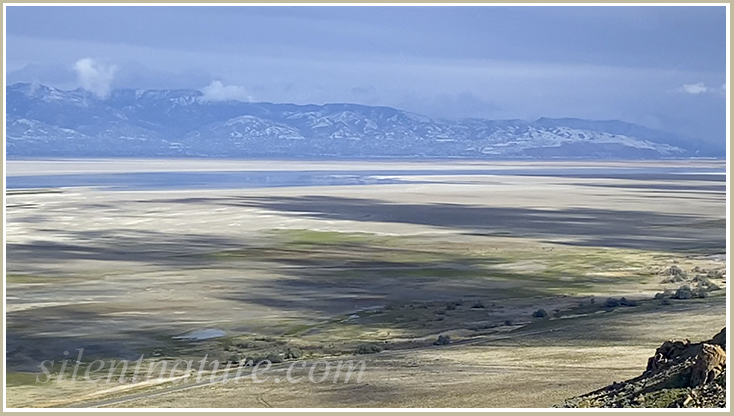
true of any of my photos. (Above Photo: View of the Great Salt Lake from Antelope Island, looking east towards Bountiful. The small pond that you see above my watermark is normally a part of the lake.) If you are the kind of person who likes to shower every day, would you like to cut back to one shower every other day? Are you willing to leave your toilet unflushed to save water? Are you willing to cut 50 per cent of the water from your lawn during the hot months of July and August? All of this probably sounds like a bit much, but the Utah Division of Water Resources says that rescuing the Great Salt Lake requires reducing water usage by 30% to 50%. That would start a very slow and gradual restoration that would take years to complete. Just eleven months ago governor Spencer Cox said, "I just encourage people to be very careful with their water consumption, it's okay to have a yellow lawn." And yet our politicians, including the governer himself, have not only approved building a massive water hungry data center in Box Elder County, but have gotten on their hands and knees and begged it to come here by offering huge tax breaks. (If this is such a profitable business whose presence is going to benefit this state, then why do they need tax breaks to "be competitive"?) They have fast-tracked this 45,000 acre data center, that will use more than twice the power of the entire state of Utah, voiding the requirement to first complete an enviromental impact study at a time when the ecosystem around the Great Salt Lake is already in deep crisis. We are told that this neglect is necessary because building the data center is a "national security issue" and that we must keep ahead of China. The truth is that the U.S. not only has the most advanced data centers in the world, but has 8 times as many data centers as the next leading country (which is Germany, not China.) According to the Deseret News a 100 megawatt data center uses 2 million liters of water per day, the equivalent of 6,500 households. Kevin O'Leary, the head of the project says that his data center is 70 percent more efficient. The trouble is that he is not building a 100 megawatt data center, but a 9 gigawatt data center, the equivalent of 585,000 households. If he is 70% more efficient, he would still be using the equivalent of 344,118 households. So exactly how are we reducing water usage by 30% to 50%? We, the citizens of Utah, live a climate where there is little water. Water is a not an unlimited resource, it is a very precious resource, and all over the west private land owners, towns, counties, and whole states are fighting for rights to the streams and rivers that flow out of these mountains. As a result we cannot sustain unlimited growth. All through the Wasatch Front I see, not just houses going up, but whole subdivisions. I see bare ground, leveled, smoothed, and ready for new lawns. Our water supply cannot sustain unlimited growth. I would not deny people the right to move here, they have as much right as I did when I first came here in 1973. And I would not deny them the right to build new houses, in fact, if construction of new houses stopped the price of existing houses, which are already out of reach for most families, would explode through the ceiling. But we could put a moratorium on new lawns. You can build a house, but you should be required to install alternative landscaping, something that doesn't demand any more water than what falls from the sky in this region. And we could definitely put a moratorium on new data centers. Governor Cox asks, if not here in Utah, then where? Why not in the Pacific Northwest where the Olympic Mountains get over 200 inches of precipitation per year, over 10 times the amount we get here? Or perhaps in an eastern state like Pennsylvania where at least they get a normal amount of precipitation? Governor Cox appealed in person to President Trump, telling him how serious our situation with the Great Salt Lake is. Consequently the federal government allocated a billion dollars in aid. How can he with one face cry that the lake is in danger and then turn his cheek and allocate billions of gallons of water away from the lake for a new data center? What does he plan to do, use the money to clean up the dry bed once the lake has vaporized? And then apply for 20 billion more to finish the clean up? Please both write and call your state representatives and the governor's office. This is serious business that will impact all of us for the rest of our lives. One scientist has said that there is a difference between a dust storm and a dust event. In a dust event we can be breathing arson and other contaminates from the dry lake bed and not even know it. He says that the particles from a dust event can carry thousands of miles...all the way to the east coast. Like I said in my last article, Utah needs to find its cash cow from other sources, not data centers. For more information on this crisis, read my article of March 1, 2026, which was written even before the announcement of one of the world's largest data centers (only a proposed data center in Ohio would be larger.) Click here: The Great Salt Lake Crisis |